From Agarwood to Osmanthus: Perfume Journeys through China


Чай та османтус: Ароматна спадщина Китаю (українська версія)
When I traveled in Vietnam, I sat at a low wooden table in Hue and learned incense-making from a master. It rained outside and the scent of blooming osmanthus filled the studio with its languid fruity aroma. The master ground woods, resins, and spices before binding them into sticks with makko powder. The recipe, he explained, had Chinese origins: agarwood, sandalwood, clove, borneol. These were ingredients once carried along the great trade routes, linking temples, courts, and homes. Watching him, I realized how much of perfume’s history rests on such exchanges.
China’s scent culture is vast. It ranges from temple incense to osmanthus blossoms in autumn, from precious agarwood to the steam of a teacup. Western perfumery rarely bottles these traditions directly, but their influence lingers, shaping some of the most interesting fragrances of the last decades.
Incense and Agarwood
Incense — xiangdao, the “way of incense” — was already central in the Han dynasty, blending woods and spices for meditation and ritual. The most exalted ingredient was agarwood (chenxiang 沉香), praised in poetry and used in Buddhist temples.
Western perfumes echo this solemnity more than they replicate it. Armani Privé Bois d’Encens and Tauer Incense Extrême capture the charged stillness of smoke in air. For agarwood, most “oud” perfumes frame it through Arabic traditions, but a taste of the Chinese lineage can be glimpsed in artisanal distillations or in incense from houses like Shoyeido, which preserve recipes rooted in Chinese practice but interpreted in a Japanese manner.
Tea and Osmanthus
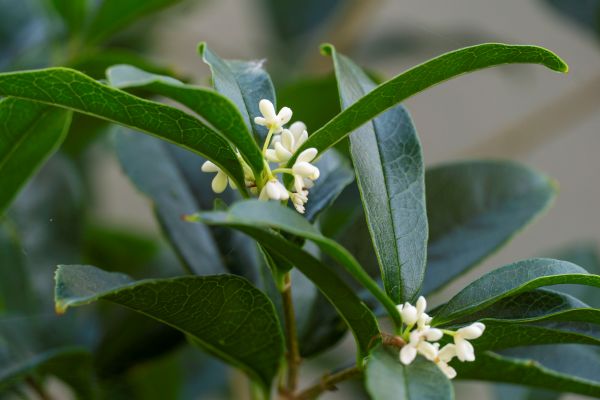
If incense belongs to temples, tea belongs to the everyday. Jean-Claude Ellena’s Bvlgari Eau Parfumée au Thé Vert drew on Chinese green tea, while Hermès Osmanthe Yunnan paired tea leaves with osmanthus blossoms from southern China. Osmanthus (桂花 guìhuā), with its apricot-jasmine perfume, scents autumn air in cities like Guilin and flavors wines, pastries, and teas. Perfumes such as The Different Company Osmanthus or Ormonde Jayne Osmanthus highlight these traditions with delicacy. Jo Malone’s Tea Collection explored Chinese varieties more directly: Silver Needle Tea (white tea, delicate and honeyed), Jade Leaf Tea (green pomelo, slightly bitter), and Midnight Black Tea (smoky vanilla). Each captures a different facet of tea.
Imagined China
Western perfumery often projects “China” through metaphors of jade, silk, or imperial gardens. Sometimes fanciful, sometimes respectful, these gestures nonetheless show a fascination with Chinese olfactory heritage. By Kilian Imperial Tea turns jasmine tea into a perfumed icon, while Pierre Guillaume Harmatan Noir frames the idea as an accord of green tea and jasmine. Ukrainian indie perfumer Sofiya Dolna made her osmanthus luscious and ripe, remarkably closed to how this note is interpreted in Asia.
The Golden Road and Beyond
As William Dalrymple writes in The Golden Road, exchanges between India and China carried not only goods but also ideas and scents. Spices from India enriched Chinese incense; Chinese aromatics reshaped tastes across Asia and Europe. When you recall that some of the most traded commodities along the Silk Road were incense and fragrant ingredients — musk, camphor, agarwood — it becomes clear that perfume, seen through this lens, is not an isolated art but a map of cultural encounters.
That map is still being drawn. Exhibitions like Notes Shanghai invite international perfumers and fragrance lovers to engage with Chinese heritage and reinterpret it for today. To encounter these scents in such a context is to realize that traditions are not fixed. They are conversations, unfolding across centuries and continents. When I travel to China later this fall, I plan to study the local artisanal market and meet the people who are weaving their traditions into something novel and original.
Exploring these perfumes through a cup of Yunnan tea, a scent of osmanthus cologne, a wisp of agarwood incense is to take part in that conversation. They are not just scents, but fragments of history carried along the Golden Road, still alive in the present.
Do you have your favorite fragrances inspired by Asian aromatics?
P.S. Besides Chinese artisanal perfumery, I also plan to learn more about Vietnamese perfumery. It’s a fascinating tradition in its own right. So stay tuned for more on this topic.