
A Beginner’s Guide – Experimental Perfume Club

By Emmanuelle Moeglin, Founder & Perfumer
In short
1
Start with two scents: one you love, and one that shifts it.
2
Look for contrast: fresh with deep, floral with woody, green with gourmand.
3
Go lighter than you think, test on skin, and write down your proportions.
There is a lot of mystique around the idea of blending your own fragrance. People picture a laboratory, raw materials and years of training. That is one kind of blending, the kind I do professionally as a perfumer. At Experimental Perfume Club we created another kind, made for you.
When we talk about blending, we do not mean mixing chemicals from scratch. We mean composing your own fragrance by combining finished scents, our Essentials, into a personal blend that no one else wears. No formulas, no pipettes, no training required. This is the whole idea behind EPC, and it is far simpler and more instinctive than it sounds. Here is how it works.

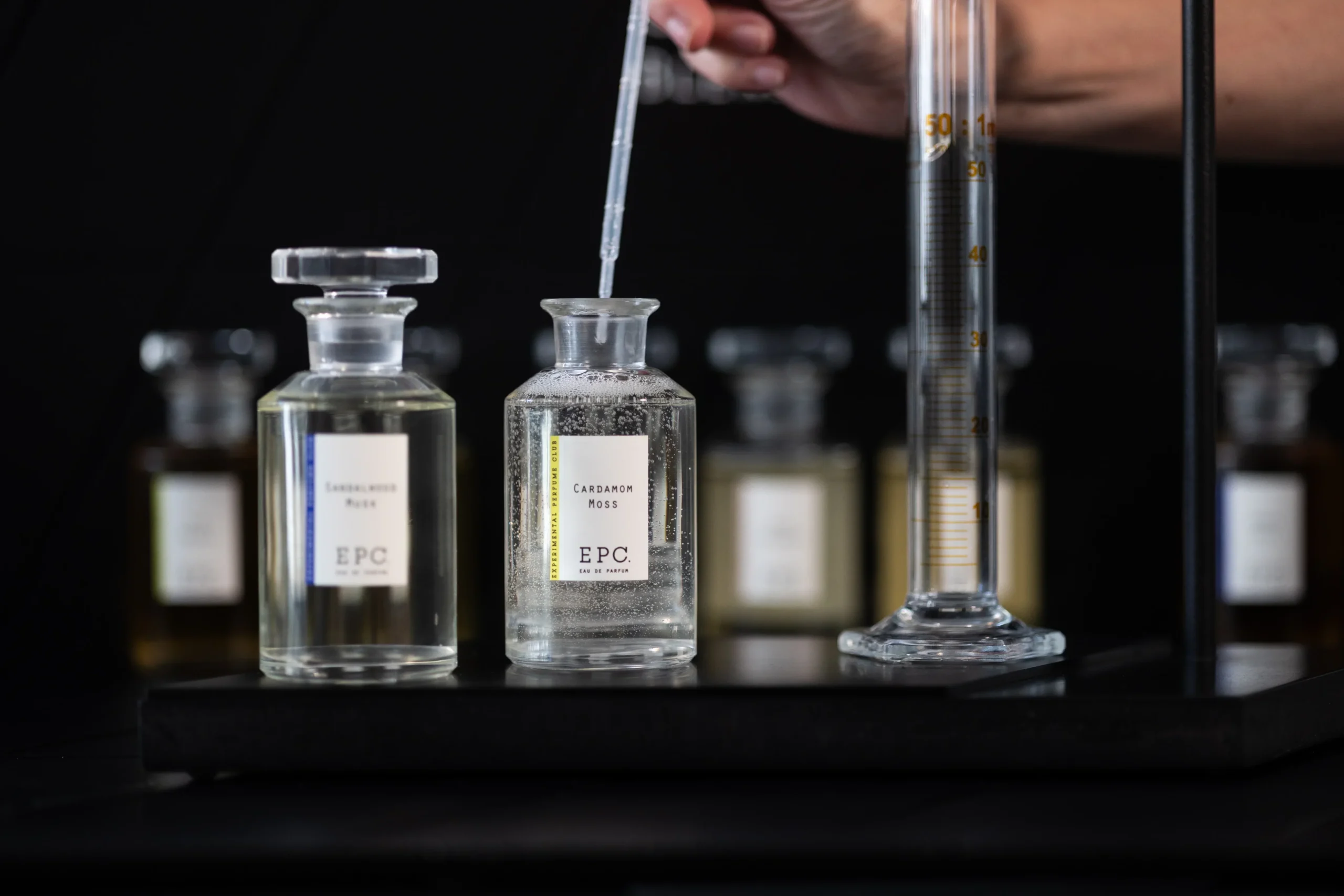
Blending, the EPC way: finished fragrances, combined into one of your own.
Looking for the other kind of blending? To make perfume from raw materials, see how to make perfume from scratch. To learn to compose like a perfumer, see how to create a perfume step by step.
What blending means at EPC
It helps to draw a clear line. A perfumer blends raw materials from scratch, balancing dozens of ingredients to build a single fragrance. That is a craft that takes years, and it is my job, not a skill we expect of you.
What we have done is take that craft and turn it into a system you can use yourself. Instead of raw materials, you work with our finished fragrances and combine them. This is close to what people call layering, wearing two scents at once, but we have designed ours to go further. Our fragrances were built specifically to be blended, so that combining them creates a new, balanced scent rather than two perfumes competing on your skin. You still recognise each one, now speaking together as a scent that is yours.
We do not mean mixing chemicals from scratch. We mean composing a scent that is yours.
The system behind it: Fresh, Mellow and Deep
This is what makes the concept work. We built our range around nine core building blocks, the Essentials, and they are the foundation of what we call the Art of Blending. Each Essential belongs to one of three olfactive families:
Because those three families mirror how a perfume is naturally structured, balance happens almost on its own: a Fresh on top, a Mellow through the middle, a Deep underneath. That is the quiet cleverness of the system. It lets you experiment freely and still end up with a blend that holds together. It is the same logic I use in the lab, simplified so anyone can pick it up.

Fresh on top, Mellow through the middle, Deep underneath.
How scents behave when you combine them
Once you start combining, it helps to know what is happening. Every fragrance is built in layers. Some materials evaporate quickly and give brightness and lift. Others unfold slowly and give depth and longevity. Combine two and these structures begin overlapping and reshaping each other.
A couple of simple examples:
Pair a bright citrus with amber or woods and you gain warmth and staying power.
Add a green or aromatic note to a floral and it turns fresher and less sweet.

Two Essentials, one new scent.
01
Step 1
Start with two Essentials
The most common mistake is reaching for too many scents at once. Start with two, whether two Essentials or two fragrances you already own. It lets you understand clearly what each one contributes.
Choose: One fragrance you already love. One that shifts or complements it.
That shift might be added warmth, a lift of freshness, less sweetness or more depth. You are not trying to disguise the first scent. You should still recognise elements of both.

One you love, one that shifts it.
02
Step 2
Balance and contrast: what works together
Contrast is usually what gives a blend movement and interest, which is why certain pairings feel so natural.
Pairing
Fresh and deep
Fresh scents diffuse quickly and feel bright on first spray, while deeper ones arrive slowly and linger.
Pairing
Floral and woody
Florals gain texture beside woods, smoke or musk, elegant because the woods give structure without crowding the flowers.
Pairing
Green and gourmand
A green or aromatic scent against a warm gourmand balances freshness with comfort.

Contrast gives a blend movement.
You still recognise each one, now speaking together.
03
Step 3
Blend for a feeling, not a note
When you blend, think less about individual notes and more about atmosphere. Do you want the result to feel fresher, softer, warmer, cleaner, more textured? That alone gives you direction.
Perfumer’s tip
If a blend feels too sharp, a Deep Essential brings warmth. If it feels too sweet, a Fresh one brings back a clean bite. This is how perfumers actually think in the lab, in effects and moods, rather than in ingredient lists alone, and it is exactly how our system is designed to let you think too.
04
Step 4
A perfumer’s tips for blending at home
A few things I would tell anyone starting out:
Go lighter than you think.
You can always add more, but you cannot take it away.
Test on a blotter first, then on skin.
Warmth and skin chemistry change everything.
Write down your proportions.
A blend you love is no use if you cannot repeat it.
Give it a moment.
Let the combination settle before you judge it, and remember a fragrance keeps rounding out over time.
Trust your nose over the rules.
The families are a guide, not a cage.

Frequently asked questions about blending fragrance
What is fragrance blending?
Blending means combining fragrances so they behave as one new scent. A perfumer does this with raw materials. At EPC we do it with finished fragrances, our Essentials, so you can compose your own blend without any chemistry.
How do you blend perfume at home?
Start with two fragrances, one you love and one that shifts it. Apply lightly, test on skin, note your proportions and build up slowly. With our Essentials, the Fresh, Mellow and Deep structure keeps the blend balanced for you.
What scents go well together?
Contrast tends to work: fresh with deep, floral with woody, green with gourmand. Each pairing balances brightness against warmth or structure.
How many fragrances should you blend at once?
Begin with two, at most three. Any more and it becomes hard to tell what each one is contributing to the blend.
Is blending the same as layering?
It is close. Layering means wearing two finished perfumes at once. Our Essentials are designed specifically to be blended, so they combine into one balanced scent rather than two competing on the skin.
Do I need any training or equipment?
None at all. That is the point of our system. You work with finished fragrances, not raw materials, so there are no formulas or tools to learn. A Creation Set gives you everything you need to begin at home.
Emmanuelle Moeglin is the founder and perfumer of Experimental Perfume Club. Classically trained at ISIPCA, with 20 years in the fragrance industry, she designed the Essentials to be blended and teaches perfumery from our central London lab.

Keep exploring
More from the Journal