
From Earl Grey to Matcha – Experimental Perfume Club

By Emmanuelle Moeglin, Founder & Perfumer
Tea is a contemplative note, much like the drink itself.
It brings a soothing, meditative quality to a fragrance, refreshing and uplifting, and it pairs beautifully with citruses and florals. Here is how perfumers capture it, from airy green tea and smoky black tea to Earl Grey and matcha, the creamy, grassy green tea everyone is talking about.

Soothing, meditative, refreshing and uplifting: tea in a fragrance.
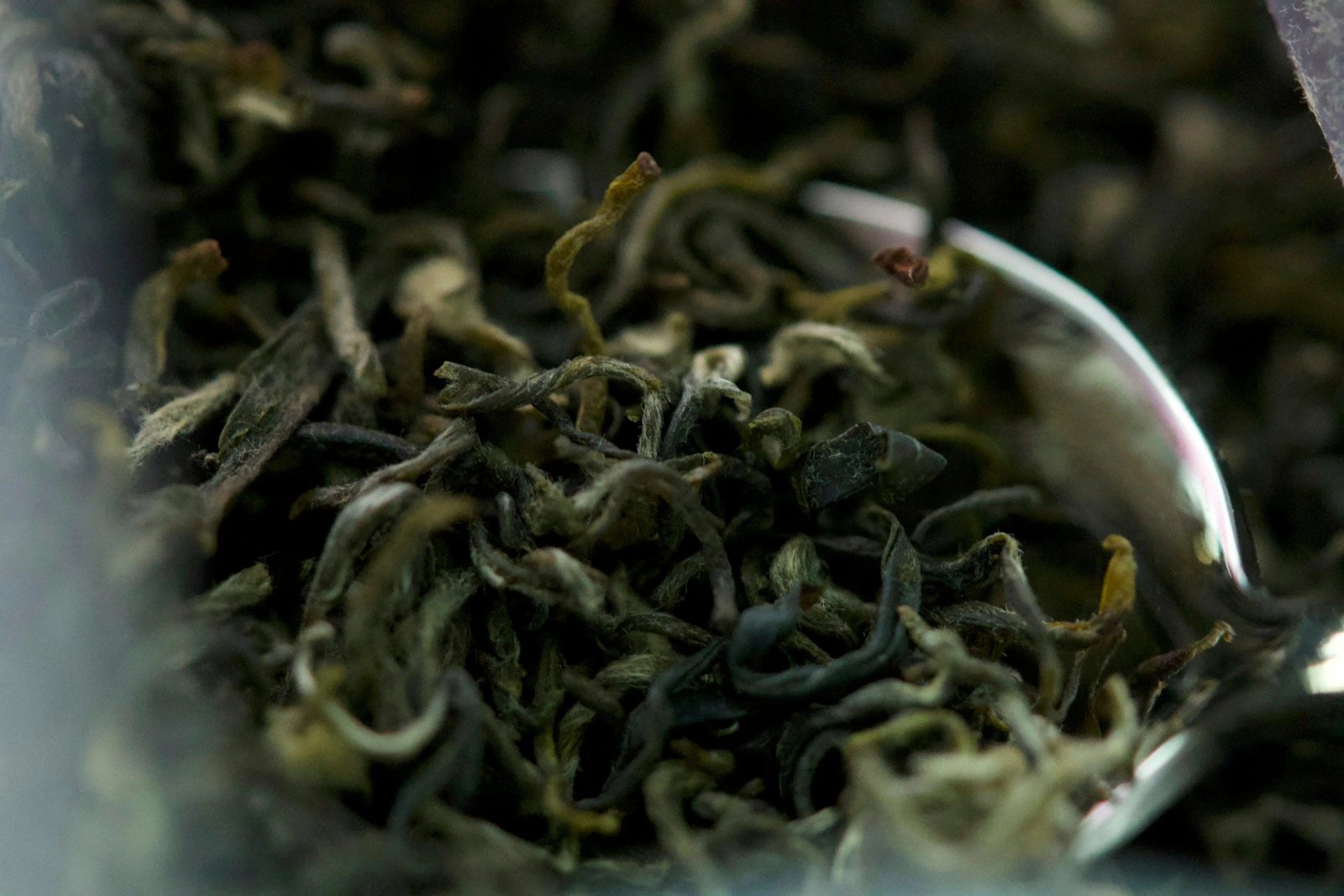
Loved everywhere, tea has been with us for thousands of years, used first as a medicinal herb before it ever became a drink. It grows across the world, from Kenya and Sri Lanka to China and India, each origin with its own character. Assam, an Indian black tea, is dark with a hint of earthiness, while green tea, often from China, is lighter and more aqueous. Earl Grey, the British favourite, owes its distinctive citrus aroma to the addition of bergamot.

Fresh · Essential
Bergamot Incense
Bright bergamot followed into incense smoke, with frankincense and iris.
Brewed tea yields no usable oil, so tea is a fantasy the perfumer builds.
A popular note in modern perfumery, tea is usually built as an accord, a “fantasy” interpretation, rather than extracted, since brewed tea yields no usable oil. The result gives an airy, soothing feel to a fragrance. Perfumers have several routes to it:
Green tea can be suggested with maté absolute in small amounts. In its pure form maté smells closer to tobacco and hay than to the watery green tea of fragrances: a strong, dry, leafy paste that clings well to base notes and adds real refinement.
Hedione, often called a transparent material, lends a luminous airiness. Combined with jasmine or herbaceous notes it creates that aqueous tea effect, which is why it appears in so many modern perfumes.
Black tea calls for darker, woodier materials. To capture the smokiness of Lapsang Souchong, perfumers reach for birch tar, cade oil, resins and woods.

From airy green tea to smoky black tea.
Tea sits close to the green notes of perfumery, and Hedione is one of the iconic synthetic molecules worth knowing.

The Academy
Fundamentals of Perfume Creation Programme
Learn how to build a tea accord, and a whole perfume around it, in our complete semi-professional online programme, with a full kit.
03
What does matcha smell like?
Matcha is the tea note of the moment, and it smells quite unlike the airy green tea of classic fragrances. Open a tin and the powder is grassy, green and vegetal, like freshly cut grass and steamed leaves, with a soft, creamy roundness and a faintly marine, savoury edge that recalls seaweed. Whisk it into hot water and it grows fuller: frothy and creamy, with an almost umami depth and a gentle bitterness at the finish.
That seaweed facet is chemistry, not poetry. Researchers analysing tencha, the leaf matcha is ground from, link its seaweed-like aroma to compounds including dimethyl sulfide and violet-scented beta-ionone, while cis-3-hexenol, the molecule of freshly cut grass, is one of the main sources of the green smell of green tea.
How is matcha different from sencha and other green teas?
All green tea comes from the same plant, Camellia sinensis. Most sencha grows in full sun: its leaves are steamed, rolled and dried, then infused in water and thrown away. Matcha begins as tencha. The bushes are shaded for several weeks before harvest, which makes the leaves a deeper green, richer in amino acids and less astringent. The leaves are steamed and dried flat, the stems and veins are removed, and what remains is slowly stone-ground into a fine powder.
You whisk that powder into water and drink the whole leaf. That is why matcha smells and tastes so much greener, creamier and more rounded than a cup of sencha, and why a matcha accord needs a different recipe from a classic green tea note.

Matcha: shade-grown tea leaves, slowly stone-ground into a fine powder.
04
How do perfumers build a matcha accord?
Like every tea note, matcha is a fantasy accord: there is no matcha oil to extract. I think of it in four parts:
A green, grassy top.
cis-3-hexenol, the leaf alcohol, gives the freshly cut grass and crushed-leaf greenness, used in tiny amounts. Violet leaf absolute adds a cool, waxy, cucumber-like green, and a drop of galbanum brings the bitter edge of a freshly whisked bowl.
Transparent jasmine.
Hedione, the airy, transparent jasmine molecule, gives the steamy, luminous feel of a cup of tea and keeps the accord light rather than heavy.
Hay and the sea.
A trace of coumarin, which smells of freshly mown hay and has been found in green tea itself, adds a dried-leaf sweetness; maté absolute can do the same with a drier, more tobacco-like accent. For the marine, savoury facet, a whisper of seaweed absolute, extracted from algae such as bladderwrack, brings an intensely marine, iodine-like note that must be dosed with great restraint.
Matcha sits between green and creamy: grass, steam and a whisper of the sea.
The art is in the balance. Too much cis-3-hexenol and it smells like a lawn; too many lactones and it becomes a matcha latte; too much seaweed and you are at the seaside. A good matcha accord sits in the middle: green, creamy, softly bitter and calm.
To explore that green, leafy freshness through the Art of Blending, our Creation Set Garden, the fresh, floral theme of the Creation Set Olfactory Library, lets you blend a fresh, green scent of your own at home.

Blend at home
Creation Set Garden
Fresh, floral materials to blend at home.
| Tea | Smells like | How perfumers build it |
|---|---|---|
| Green tea | Light, airy, aqueous | Hedione with jasmine or herbaceous notes; a little maté absolute |
| Black tea (Assam, Lapsang Souchong) | Dark, earthy, woody; smoky for Lapsang | Birch tar, cade oil, resins and woods |
| Earl Grey | Black tea lifted by bright citrus | Bergamot over a black tea accord |
| Matcha | Grassy, creamy, vegetal, faintly marine, softly bitter | cis-3-hexenol, Hedione, milky lactones, a trace of coumarin or seaweed absolute |
06
Tea in an EPC scent: Soleil d’Hiver
You can smell exactly this in our Soleil d’Hiver, a rose in the frost. Cardamom and pink peppercorn open icy and crisp around a heart of Moroccan rose, cooled and held in check by oolong tea, with sandalwood, leather and tobacco glowing faintly underneath. The oolong does what tea does best in perfumery: it lends an airy, contemplative calm that keeps the rose from turning sweet, the quiet centre of the composition.
Three Essentials, one Blend

Blend · Cardamom Moss + Rose Rhubarb + Sandalwood Musk
Soleil d’Hiver
Cardamom, pink peppercorn, Moroccan rose and oolong tea.
Questions
Frequently asked questions about tea in perfume
What does tea smell like in perfume?
Airy, soothing and refreshing. It can be light and aqueous like green tea, or dark, woody and smoky like black tea, depending on how it is built.
Is there real tea in perfume?
Rarely. Brewed tea yields no usable oil, so a tea note is almost always an accord, built from materials like maté absolute and molecules such as Hedione.
What’s the difference between green and black tea notes?
Green tea notes are light, fresh and aqueous; black tea notes are deeper, woodier and sometimes smoky, as in Lapsang Souchong.
What does matcha smell like in perfume?
Grassy, green and creamy, with a soft vegetal, faintly marine facet and a gently bitter finish. It is fuller and milkier than a classic green tea note, closer to a freshly whisked bowl than a cup of sencha.
How is a matcha note made in perfume?
As an accord, since there is no matcha oil. Perfumers combine green molecules such as cis-3-hexenol with transparent Hedione, milky lactones and tiny touches of hay-like coumarin or marine seaweed absolute.
What is Hedione?
A transparent, airy molecule that brings a jasmine-tea radiance to a fragrance. It is one of the most widely used materials in modern perfumery.
What pairs with tea notes?
Citrus, most famously bergamot in Earl Grey, along with florals like jasmine and fresh green notes.
How do you wear a tea fragrance?
As a light, uplifting, calming scent. Tea notes are lovely for daytime and warm weather, and very easy to wear.
About the author
Emmanuelle Moeglin
Founder and perfumer of Experimental Perfume Club. Classically trained at ISIPCA, with 20 years in the fragrance industry, she is a member of the French Society of Perfumers, a multi-award-winning creator and a public speaker. She designs the house’s blends and teaches perfumery from our central London lab.
Keep exploring
More from the Journal